The 2012 Aluminum Wave: A Poker Case, a $385 Realforce Housing, and an Argument About Money
In one summer, Korean enthusiasts put aluminum around the Vortex Poker and the Realforce, and discovered that making things for your friends is complicated.
The Korean custom scene did not only build keyboards from scratch. It also put aluminum around keyboards other people had made, and 2012 was the year that habit became a wave. Two posts from that summer, one a maker's statement and one a buyer's review, show how it looked from each side. A third, from four years earlier, shows where the idea came from.
2008: KennyP's Realforce 86 kit
Leopold had announced the tenkeyless Realforce 86 in March 2008. By July a KBDMania member known as KennyP had run a gongje for an aluminum custom kit for it, and a member called 펠 posted his build. The kit came as a top and a bottom; the bottom was "heavy enough to double as a weapon." You removed the Realforce's plastic top (the reviewer forgot, and had to reassemble; KennyP corrected him in the comments), fitted a rubber ring around the USB port, and dropped the board in. Each box included a bag of almond candy "so your mouth isn't bored while assembling."
The reviewer's notes on feel are an early version of a conversation Korea would have for the next decade. The board felt heavier to type on; the 35 g keys on his variable-weight Realforce now felt barely different from the 45 g ones, "as if the whole keyboard's weight had been unified." The palm-rest slope was comfortable. And "being aluminum, it even feels a little cool in this heat. In winter it'll be cold." That last joke recurs in Korean reviews of metal cases to this day.
June 2012: an aluminum Poker, and a defence
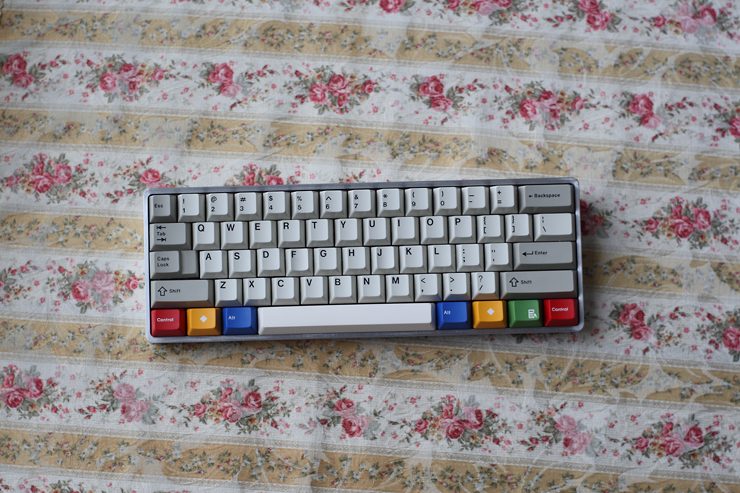
The Vortex Poker, a 60% board from Taiwan, had become the Korean enthusiast's second keyboard. On 27 June 2012 a member posting as 플라나티스타 (Planatista), who described himself as a "total beginner" who had joined only three months earlier, showed the second sample of an aluminum housing for the Poker. He owned, he said, a Poker, a TG3, an MX-mini and an HHKB Pro 2, and had fallen for an aluminum Poker case he bought from another member. "Why has no one run a gongje for a proper aluminum Poker housing?"
He had commissioned one for himself. Then members started "lining up" in the comments and he changed course. The rest of the post is about what happened next, and it is the clearest statement in the archive of the pressure a gongje maker was under in 2012.
"The club is unsettled right now. People say I'm doing business, that I should attach receipts. I want to say one thing. I have never once thought of this as profit. How much could I earn from this? I'd make more spending that time on my actual job." He had, in three months, reached Level 9 and almost 8,000 points, which he offered as evidence of how much he cared. He admitted the process left a small buffer of money and asked people not to call that profit. He apologised to his supplier for squeezing the price "because I know KBDMania members." And he closed with a line that doubled as a dedication to every maker before him: "I respect KMAC and the others who ran gongje. Who dares throw stones at that work? I'd tell those people: try it yourself." The samples were not even bolted together; he warned that the photos would show small gaps. Fifty-eight people commented. By October another member had posted his Poker housing fitted with a set of 38GT keycaps.
September 2012: a Realforce alu from eBay, $385
Topre's own Realforce 10th anniversary aluminum housing reached Korea the hard way. In September 2012 a member called KeithPark wrote that he had been waiting for a proper review, given up, and bought one in an eBay auction that the seller had apparently listed by mistake. He won it at $385, which his card statement rendered as ₩452,960. "If it had gone to $400 I'd have been in trouble." He chose gray because he didn't own fancy Realforce keycaps.
The review is a careful one. The packaging was EVA foam, which he thought must have cost a fortune. The box held two brass feet, silicone feet, screws and a 2 mm hex key. The internal machining left visible tool marks, the outside was clean, and the anodizing was good. Assembly meant unplugging the Realforce's internal connector, removing a screw that would otherwise prevent the case closing ("you'll understand when it happens to you"), and dropping the board in; the integrated USB hub lived in the top case. He measured the finished height at 23.95 mm, against the roughly 20 mm of a typical custom and the 27 mm of the acrylic A87 he had started on, and found it thick.
The comments did the economics for him. "Until the day a Realforce alu housing gets a gongje..." wrote one member. "45 jeom is too expensive." Another had already built his own aluminum Realforce case at home, with a lit Realforce logo, and had spent a long evening with a vernier caliper making sure the keycaps did not sink.
What the wave left behind
By the end of 2012 a Korean enthusiast could buy or build an aluminum case for a Poker, a Realforce, a Majestouch, or a 356, KMAC or LZ. The three posts above explain why the Korean version of that trend looks the way it does. The weight and the "cool in summer" aesthetic were in place by 2008. The expectation that a maker works at cost, and will be publicly accused of profiteering if anyone suspects otherwise, was fully formed by 2012. And the benchmark price, the one every Realforce-case review was measured against, was not Topre's. It was the number a member would charge for a gongje.
Sources in the KBDMania archive
These are the original Korean posts this article is built from. They are written by community members; the English text above is our own summary, not a translation.