The Korean Custom Keyboard Scene, Explained From the Inside
Western enthusiasts know the names. Here is where they came from, in the order it happened, with the original posts.
If you have spent any time on geekhack or r/MechanicalKeyboards, you have seen Korean custom keyboards treated as a kind of founding myth: heavy aluminum, tiny production runs, names passed around in hushed tones, and almost no primary sources in English. People still turn up on KBDMania's old English board asking the same question they asked in 2012. "These keyboards have been floating around the picture thread for a while, and there are so many variations," one visitor wrote that year. "Is this some sort of, here's the PCB, here's the acrylic thickness, go build your own keyboard project?" In 2023 someone was still asking for a list of every LZ ever made.
This series is an attempt to answer those questions from the inside, using the posts where it actually happened. KBDMania has been online since 2002 and its archive holds about 220,000 posts. The group-buy announcements, the delivery-day photos, the arguments about price: they are all still there, in Korean. We read them so you don't have to.
The short version
Korean customs did not start with a company. They started with a hobbyist posting a spec sheet on a free board.
- 2008: the 356 series. A member known as 응삼 (Eungsam) runs a 60-unit group buy for the 356-L, a tenkeyless aluminum housing that reuses the controller from a Cherry G80-3491 so nobody has to solder. It sells out. A brown-switch version, the 356-N, follows in July. By 2009 there are 356CL and dark editions, and the first questions about them appear on the English board. Part 2 covers the 356.
- 2008 to 2010: the split. KBDMania's member group-buy board is closed in mid-2008. The 356 runs move to a sister site that becomes OTD, which grows into its own community centred on projects and vintage boards. Relations between the two sites are complicated and, by 2010, publicly tense. Many people are members of both.
- 2008 to 2012: the word for all this is 공제 (gongje). Not quite a Western group buy. A gongje is run at cost by a member, in a fixed quantity, and the community polices resale. A 2012 post lists the going prices for every major Korean custom to date. Part 3 explains the culture and the numbers.
- 2011: KMAC. KBDMania's own project team announces KMAC, "Keyboard Mania Attic Craft": a full CNC aluminum tenkeyless with an in-house PCB and controller, hardware macros, remappable firmware, and a kit price around 280,000 won. It is the first custom designed and shipped under the KBDMania name. Part 4.
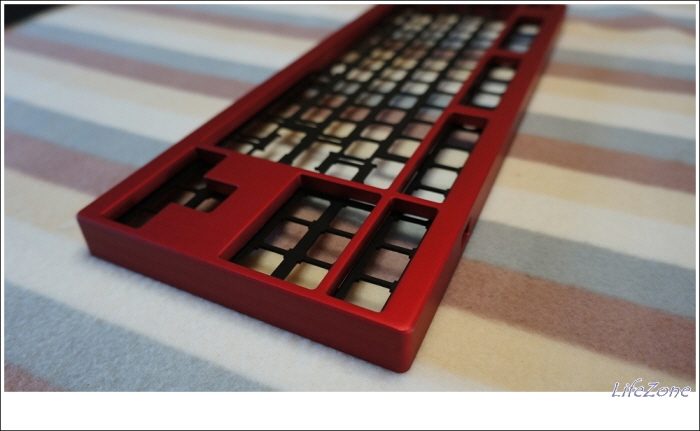
- 2012: LZ. A member called LifeZone documents an aluminum tenkeyless from 3D model to anodizing in a photo-board thread, makes three sets, and names it LZ.87. Within months there are LZ-SE and LZ-F runs and the name becomes the one Westerners remember. Part 5.
- 2012: the aluminum wave. The same year brings a member-run aluminum housing for the Vortex Poker, imported aluminum cases for the Realforce, and a lot of arguing about what any of it should cost. Part 6.
- In parallel: Leopold. The Korean importer that persuaded Topre to make a tenkeyless Realforce in 2008 goes on to design its own Cherry boards and, in 2013, to manufacture the FC660M in Korea. KBDMania's news board carried each announcement, and the comment counts (679, 606, 980) tell you how much the community cared. Part 7.
Why it looks the way it does
Three things shaped the Korean custom aesthetic, and all three are visible in the 2008 356-L announcement.
Tenkeyless first. The 356-L was a TKL because the community had already decided that TKL was the serious person's layout, and because a tenkeyless could reuse the controller of a full-size Cherry G80-3491 donor. The Realforce 86, which Leopold had just announced, was also a TKL. Full-size customs were rare from the start.
Heavy, one-piece, matte. The 356-L spec promised a "one-piece design where everything fastens to the top housing," glass-sanded and anti-dust-coated anodizing, and a matte black finish "like production keyboards." Four years later LifeZone was still describing the LZ.87 in the same terms: no side seam, bottom slotting into the top, semi-hard anodizing. Weight was a feature. A completed KMAC was estimated at over 1.5 kg; one owner added half a kilo of brass to make it heavier.
No soldering if possible, then soldering as a hobby. The 356-L's headline feature was that you could move the whole controller board over from a G80-3491 and be done. By 2011 KMAC shipped with every component pre-soldered except the switches, and members were posting switch-opening tutorials in preparation. Assembly services (공방, "workshops") appeared, and the quality of your workshop's stabilizer work became a topic in its own right.
What this series is not
It is not a complete catalogue. Korea produced many more customs than the ones covered here, several of them on OTD rather than KBDMania, and later makers known in the West built on this foundation outside this archive. What we can do is show the posts where the foundation was laid: who announced what, what it cost, how people reacted the day it arrived, and what they argued about afterwards.
Every article links its sources at the bottom. The originals are in Korean; a browser translator will get you most of the way.
Sources in the KBDMania archive
These are the original Korean posts this article is built from. They are written by community members; the English text above is our own summary, not a translation.