Why Korean Topre Owners Say: Don't Lube Your Domes
Two of the most-read posts in KBDMania's history are about what goes wrong inside a Realforce. One shows ruined rubber domes; the other spends three days with silencing rings.
Korea took to Topre early. KBDMania reviewed the Realforce 101 in September 2003, Leopold imported it with Hangul legends by 2007, and by the mid-2010s the Realforce, the HHKB and Leopold's own FC660C were as common on Korean desks as Cherry boards. Korean enthusiasts call the technology 무접점 (mu-jeop-jeom), literally "no contact point," and they have accumulated a body of folk knowledge about it that English-language guides mostly lack. The two posts below, both promoted to KBDMania's Best Article board, are the core of that knowledge. One is a warning. The other is an experiment.
2016: the ruined 660C
In July 2016 a member posting as 순수 bought a used Leopold FC660C from "a good person at a good price," intending to take it apart anyway. Something felt off the moment he typed on it. So he opened it.
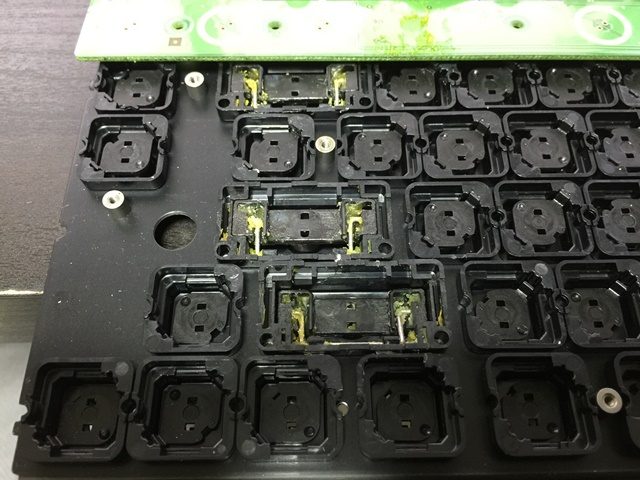
What he found, photographed in detail: stabilizers that had been lubricated badly and heavily; lubricant that had migrated onto the PCB; and under the stabilized keys, rubber domes that had deformed, sagged, and in places folded over each other until, as he put it, the keys "felt like a rubber-dome keyboard." Neighbouring domes had stretched too. The seller, he suspected, had no idea the board had been lubed at all, and may have come away quietly disappointed with Topre as a result.
The repair was the point of the post. You cannot just pull the stabilizer sliders and wipe them. The domes, every slider, every spring and the PCB all needed degreasing, and because the grease was moisture-resistant it would take a long time and never come fully out. Separating sliders from the plate chips the small locating nubs on their sides, so the board would never be as new. And the hardest part: Topre does not sell rubber domes. Your options were to trim the deformed domes and type on something mushy, or hunt for a donor board.
Then the paragraph that gave the post its reputation. "Please... think very carefully before lubricating a capacitive board, and honestly, I strongly recommend just using it as it is." Topre, he argued, changes with age no matter what you do; put two examples of the same model side by side after two or three years and "the feel and the sound are completely different." It "ripens and wears naturally," so the pleasure of a careful lube job "is likely to last only a moment."
The 116 comments are a cross-section of Korean Topre opinion in 2016. Lube stabilizers only, lightly, said several. New or near-new boards should not be touched; a neglected second-hand board might justify a light application of a verified lubricant, said another, who also pointed out that Topre's silent sliders have a recess underneath so that a silencing ring does not press the dome, while standard sliders do not. One commenter kept a small, unused jar of Krytox 205 at home purely so he could tell people asking by private message to use that or nothing. The recurring worry was the second-hand market: "lubed used boards: always be careful."
2017: three days with silencing rings
Seven months later a member called Stephen posted a very different kind of article: a reference review of silencing a Topre board with HyperSphere rings, the aftermarket rings sold on eBay and discussed at length on geekhack. He had tried everything else first. Silicone O-rings cut from pads had failed in two ways: they rolled up and blocked the keycap's return, causing repeated inputs, and their thickness shortened the stroke so the dome sat partly compressed. He had solved his FC980C by buying a Realforce silent model on Amazon and swapping in all of its sliders. Now he wanted a method that did not require sacrificing a second keyboard.
The 107 rings arrived in about ten days, "pricey, but cheaper than destroying another Realforce." What he found, with photographs and a Dremel, is the part nobody had written down:
- Topre's original silencing ring for stabilized keys is about 0.6 mm thick, double the roughly 0.3 mm of the rings on ordinary keys. The HyperSphere rings are all 0.3 mm.
- To make room for the thicker rings, Topre's silent-model stabilizer slider housings are taller than the standard ones. The sliders themselves are identical in every dimension. So swapping in silent sliders alone does not make a board silent-spec; "you have to replace the housings as well."
- The HyperSphere rings are slightly larger and looser than Topre's; on ordinary sliders a stopper keeps them in place when the board is inverted, on stabilizer sliders they simply fall out.
- The HHKB, as far as he knew, has integrated slider housings, so this route is not available there at all.
After three days he had solved the dome-compression problem on the stabilized keys and had not solved the shortened stroke. The comment thread's conclusion was the one many Korean readers had already reached: "If you want silent, buy the silent version from the start." One commenter was blunter: "Extraordinary effort and sincerity. I absolutely cannot agree with the last line. I learned a lot."
What the two posts have in common
Both are written by people who opened the keyboard rather than take someone's word for it. Both are suspicious of the idea that modification is automatically improvement. And both end up at the same practical advice for a Topre owner: leave the domes alone, lube the stabilizers lightly if you must, and if you want a silent board, buy one, because the silent version differs in parts you cannot buy separately. Korean Topre culture is sometimes described as conservative. On the evidence of these posts it is better described as experienced.
Sources in the KBDMania archive
These are the original Korean posts this article is built from. They are written by community members; the English text above is our own summary, not a translation.