The 2008 Post That Taught Korea Its Cherry Switches
Before the English-language switch guides, a KBDMania member took apart a Cherry MX, measured it against the datasheet, and gave Korean modding its vocabulary.
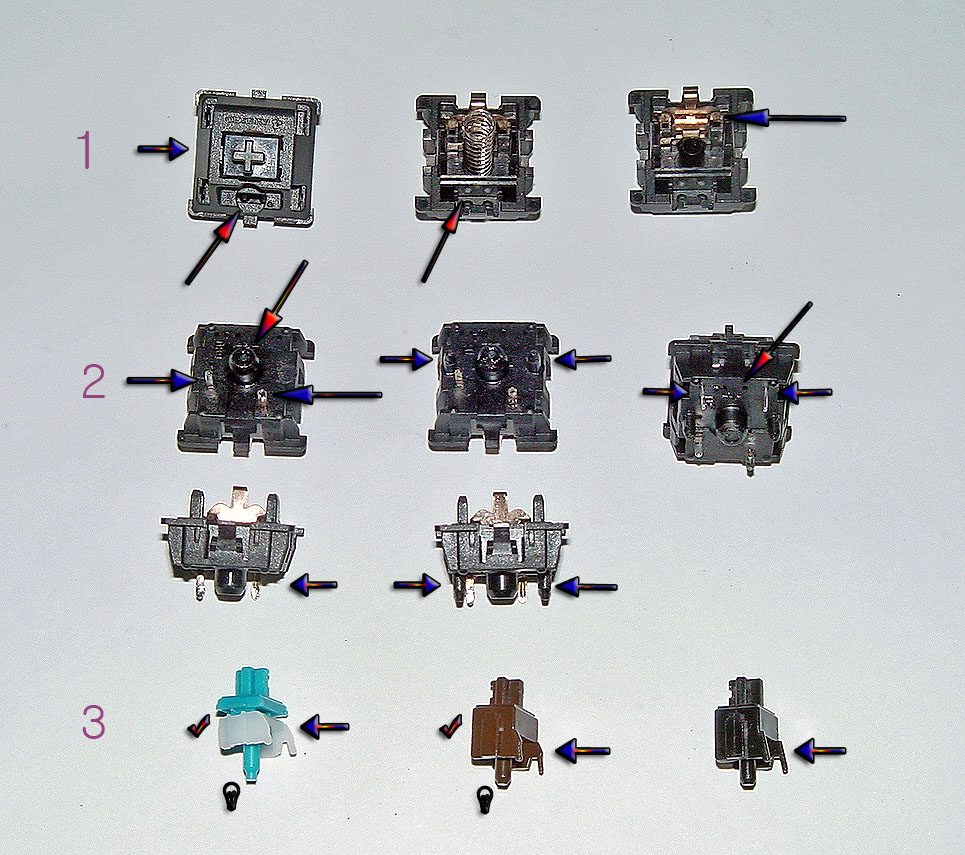
On 22 March 2008, nine days after the 356-L group buy opened, a member posting as 스카페이스 (Scarface) put a long tutorial on KBDMania's Tips & Tech board under the title "Understanding Cherry switch construction: black, brown, blue... the bottom and the plate." It has been read about 75,000 times, which for a 2008 Korean forum post about switch internals is a remarkable number, and it did for Korea roughly what the first big geekhack switch guides did for the English-speaking hobby a few years later. It is also where some of Korean modding's basic vocabulary comes from.
A tutorial for people about to build a keyboard
The timing was not an accident. Sixty people had just committed to assembling a 356-L, and many of them had never opened a switch. Scarface was explicit about the audience: "an explanation to help beginners get the concepts," for people who understood Cherry switches "vaguely, as if they knew and didn't." He admitted he had learned it himself by "blindly taking things apart and fumbling."
The post opens with the lineup as it stood in 2008: black, brown, white and blue as the core, with gray and green as the heavy "support" variants used for spacebars and Enter keys. Each gets a one-line character sketch that Korean reviewers have been paraphrasing ever since. Black: "linear... slides straight to the bottom without catching: shook-tak!" Brown: "catches in the middle: dalgeurak-tak!", and the catch, he explains, is what the community calls 구분감 (gubun-gam), the "sense of distinction" by which "your fingertip notices: ah, I've pressed this far." White: a brown "with seasoning," stronger bump, heavier. Blue: "dalgeurak-jjaegak-tak!", bump plus click, lightest to press.
Datasheet versus kitchen scale
Then he does something most guides of the period did not: he compares Cherry's published actuation figures with what he measured himself.
| Stem | Cherry spec (2008 datasheet) | Measured by the author |
|---|---|---|
| Black | 60 g ± 20 g | about 80 g |
| White | 55 g ± 20 g | about 85 g |
| Brown | 45 g ± 20 g | about 55 g |
| Blue | 50 g ± 15 g | about 55 g |
"The tolerance range is enormous," he notes of the datasheet, and his own numbers are clearly bottom-out rather than actuation forces. But the point of the table was not precision. It was to show that the number on the spec sheet and the number in your fingers are different things, which is the premise of spring swapping.
변흑, 변청: naming the spring swap
That leads to the sentence that gave Korean modding a word. "Removing the stock spring and fitting a different one, usually lighter, is called a 변형축 or 변태축," a "modified stem." Combine the first syllable with the colour and you get 변흑 (byeon-heuk, a black with a lighter spring), 변백, 변갈, 변청. The terms were already in use on the free board that month, where someone was quietly planning to buy "a Wyse 변흑" while everyone else chased the 356; by 2013 KMAC owners were describing their boards as "변흑, 62 g, fully lubed." If you have ever seen a Korean listing for a "변흑 키보드" and wondered what the first word meant, this is the post that fixed it.
The rest of the anatomy
The remaining sections walk down through the switch with photographs: the cross-shaped stem and its colour; the round recess that takes an LED or a diode ("the diode is needed if you're making the keyboard NKRO"); the four holes in the base, two for an LED and two for a diode or wire; the spring, whose length, stiffness and winding set the weight; and finally the contact leaves, gold-plated, one horizontal and one vertical, which he introduces as Cherry's "gold cross-point" design. He notes which parts connect to the PCB and how the stem's travel opens and closes the contacts.
The comments show what landed. "I used to only see the first picture, after pulling a keycap. Seeing it this closely, it clicks." "Now I finally know what the 'wings' are." And, twice, the same gentle complaint: "The plate explanation is 2% lacking." He had promised the bottom housing and the plate in the title; readers wanted more of it. They would get it. By the time KBDMania's project team was preparing KMAC in 2011, a member was posting "pre-study material for KMAC assembly: let's open a switch," and the people reading it had grown up on this one.
Why it matters outside Korea
KBDMania had covered the basics before: a 2003 article on click, tactile and linear, a 2004 piece titled "The secret of simultaneous input: about N-key rollover." What Scarface's post added was the hands-on layer, written for people who were about to solder sixty-odd switches into an aluminum case and wanted to know what they were putting in. That combination, a custom group buy landing in the same month as a teardown tutorial, is how Korean modding culture got its start: not as a guide to be read, but as homework for a keyboard that was already on its way.
Sources in the KBDMania archive
These are the original Korean posts this article is built from. They are written by community members; the English text above is our own summary, not a translation.