KMAC (2011): The Custom Keyboard KBDMania Built Itself
Keyboard Mania Attic Craft. An in-house PCB and controller, hardware macros, full CNC aluminum, and a kit price under a Realforce.
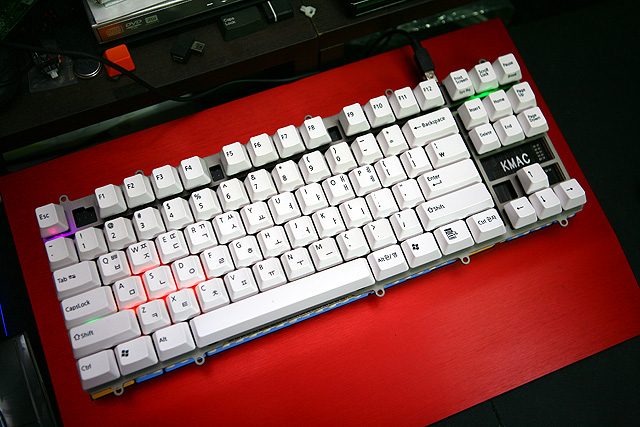
By 2011 the 356 line had moved to OTD and KBDMania, the older and larger site, had no custom of its own. On 30 August 2011 a member named 김재연, posting as 메룩스짱 (Merux), put a set of spy shots on the news board with the line: "Here is something we've been ambitiously preparing in the KBDMania attic." The name was KMAC, for Keyboard Mania Attic Craft (케이맥). The first comment asked the obvious question: "So customs are finally being made at KBDMania too?"
What was different about it
Earlier Korean customs had been housings built around a donor controller. KMAC was a platform. The spec list in the first post, repeated and expanded three weeks later, reads like a feature list for a 2020s custom:
- Caps Lock and spacebar positions compatible with both Majestouch and Cherry keycaps, chosen at switch-mounting time.
- All components on the back of the PCB, so parts could be replaced or repaired after a full-plate build without pulling switches.
- USB connector or fixed cable, your choice; PS/2 or USB with a simple adapter, with NKRO in PS/2 mode.
- Hardware key macros and key remapping, each with its own program.
- Adjustable key repeat rate, in hardware.
- WASD backlighting, toggled by a key combination; macro-mode LEDs on F1 to F12.
- No ISP loader required. Assemble the board, load the "key binary" (the keymap) over USB, done, including on the latest 64-bit operating systems.
- Caps Lock and left Ctrl swappable, with the LED following.
- ESD protection on the IC.
- Full CNC aluminum housing with aluminum plate. Mac compatible.
The second post added the sentence that defined the project: "The controller section and the PCB were developed in-house by the KBDMania project team, from design through manufacture." The housing was "being machined at the factory right now." Ten closed beta testers had been selected and would receive boards the following week to report bugs. The prototype in the photos was built on PCB version 1.1 to confirm Majestouch keycap compatibility; the group buy would ship version 1.2 "for a few more new features."
The timeline and the price
The September post laid out a schedule: bug reporting and closed beta through the end of the month; a reveal of the finished board with aluminum housing in early October, in winkey and winkeyless versions; group buy in mid-to-late October; production from late October to mid-December; delivery by year end. A February 2012 photo-board thread titled "KMAC pickup meetup" suggests the last step ran a little late, which is also traditional.
On price, Merux was coy but pointed: with all those features and a full CNC aluminum housing, KMAC would be "far cheaper than a Realforce." The 2012 community price list records the result. A KMAC kit was 28 jeom (about ₩280,000): housing top and bottom, aluminum plate, PCB with everything but the switches pre-soldered, two-stage aluminum feet. A KMAC LE was 22.
The kit philosophy was explicit. "KMAC is made so that you can assemble it as easily as possible," the second post said, and the community prepared accordingly. In October 2011 a member posted "Pre-study material for KMAC assembly (2): let's open a switch," which collected nearly 12,000 views. Switch opening, spring swapping and lubing were about to become mainstream hobbies in Korea, and KMAC was the board people did them for.
Life after delivery: KMAC2 and half a kilo of brass
A second version, KMAC2, followed with a self-angled aluminum housing (자체 경사, meaning the typing angle is cut into the case rather than provided by feet). The comparison between the two produced one of the archive's more methodical mod posts. In August 2013 a member called 지노다 reported that his KMAC2, built with 62 g springs by a different assembly workshop, felt nothing like his original KMAC with the same spring weight. He suspected the housing's structure and mass, and set out to test it by making the KMAC heavier.
He ordered a brass sheet cut to 347 × 121 × 1.5 mm. Brass has a density of 8.4, so theory said 529 g; the scale said 526 g. Slid into the 2 mm gap between PCB and bottom case with foam, it took the keyboard from an estimated 1.55 kg to about 2 kg. The first attempt, with thin memory foam, made typing so stiff that "vibration transmits to the fingertips, and eventually they go numb." The second attempt, with thick foam, left the board so tightly packed that keys misfired when the screws were fully tightened. The post is a reminder that "heavier is better" was a hypothesis the community tested rather than a slogan it repeated.
Why KMAC matters
Three things. It was the first custom to carry the KBDMania name, which mattered to a community that had watched the 356 leave. It was the first Korean custom whose selling point was the controller rather than the case: remappable firmware, macros and NKRO were features you paid for in 2011, and KMAC bundled them into a kit cheaper than a Realforce. And it normalised the idea that a custom was something you assembled, with pre-study threads, assembly workshops and meetups built around the fact. The aluminum got the photographs. The PCB got the next decade.
Sources in the KBDMania archive
These are the original Korean posts this article is built from. They are written by community members; the English text above is our own summary, not a translation.